Mohale Dam
Type: Rock-Fill, Face Slab Dam
Construction Date: May 1995 - October 2001
Location: Mohale, Lesotho
S 29.457535° E 28.097062°
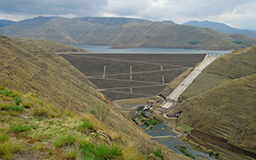
Mohale Dam, Situated in the Lesotho Highlands near the town of Mohale, is a 145m High Rock-Fill Face-Slab (RFFS) structure with a 620m long crest.
The Dam is situated in the Senqunyane River and construction started in March 1998.
In contrast to Katse's high-tech structure, Mohale works on a simple principle - a mass of rock compacted across a valley, add a concrete face slab to make it relatively waterproof. Mohale dam is considered to be large by world standards and consists of 7, 8 million m3 of compacted rock, 600m thick at the base, and 10m thick at the crest.
Dam capacity is large and active water storage volume is 947 million m³.
During construction an earth fault on the right flank was discovered and an observation tunnel needed to be constructed for close observation of this earth-fault. The inspection tunnel houses various Vibrating Wire Rod Extensometers for monitoring the fault movement.
Mohale Dam Instrumentation consists of the following:
Instruments installed in and around the Dam Embankment are intended to monitor:
Installed Instruments Specification:
Designers: N/A
Consulting Engineers: Mohale Consultants Group(MCG) comprising SMEC (Snowy Mountains Engineering Corp of Australia), BKS, Melis & Du Plessis and Steward Scott Incorporated (SSI) of South Africa, Harza Engineering of the USA and Nippon Koei Co. of Japan
Contractors: The Contractors comprised a joint venture of Hochtief (germany) contract leader Impregilo (Italy) and Concor Roads & Earthworks (South Africa)
The Dam is situated in the Senqunyane River and construction started in March 1998.
In contrast to Katse's high-tech structure, Mohale works on a simple principle - a mass of rock compacted across a valley, add a concrete face slab to make it relatively waterproof. Mohale dam is considered to be large by world standards and consists of 7, 8 million m3 of compacted rock, 600m thick at the base, and 10m thick at the crest.
Dam capacity is large and active water storage volume is 947 million m³.
During construction an earth fault on the right flank was discovered and an observation tunnel needed to be constructed for close observation of this earth-fault. The inspection tunnel houses various Vibrating Wire Rod Extensometers for monitoring the fault movement.
Mohale Dam Instrumentation consists of the following:
- Convergence points in the Outlet-Tunnel measuring expansion/contraction.
- Vibrating Wire Strain Gauges in and around the Outlet-Tunnel measuring concrete and re-enforcing strain.
- Vibrating Wire Load Cells and Vibrating Wire Pressure cells measuring total load and pressure.
- Vibrating Wire Piezometers measuring pore pressure.
- Five sets of Vibrating Wire Perimetric Joint Meters are installed on crucial structural points on the plinth and the concrete face slab, measuring three-dimensional movement between the plinth and the starter slab.
- Eighteen Wire Embedment Jointmeters are installed in the top parts of the various vertical joints of the concrete face slab measuring movement between the joints.
- Two Horizontal Inclinometer casings on the face slab measuring deflection of the face slab as such.
- Vibrating Wire Settlement Cells in the rock-fill for measuring settlement.
- Standpipe Piezometers for measuring water table.
- Vibrating Wire Transducer measuring seepage.
- Vibrating Wire Rod Extensometers measuring zone movements in rock.
- Mechanical Rod Extensometers measuring zone movement in rock.
Instruments installed in and around the Dam Embankment are intended to monitor:
- Settlement of the Embankment;
- Pore pressure within the Embankment and foundations;
- Opening of the concrete face slab joints;
- Stresses and deflection in the face slab concrete and fault line;
- Rock zone movement;
- Measurement of the starter slab and the plinth;
- Total pressure and Load;
- Strain within the face - slab.
Installed Instruments Specification:
- Seepage (Dam, Conduit and Spillway)
- • Geokon Vibrating Wire Transducers Vented Model 4580
- Piezometers (Clay Core against Retaining Wall)
- • Geokon Vibrating Wire Model 4500S
- Joint Meter (Concrete face and plinth)
- • Geokon Vibrating Wire Model 4400
- Strain Gages (Face and Conduit)
- • Geokon Vibrating Wire Model 4210/4200/4202
- Pressure Cells (Conduit and Main Embankment)
- • Geokon Vibrating Wire Model 4800
- Settlement Cells (Fill)
- • Geokon Vibrating Wire Model 4650
- Convergence Meters (Conduit)
- • Geokon Model 1610 Tape Extensometer
- Data Acquisition System CR800/1000 (Valve House)
- • Geokon Micro-1000 Data logger Model 8021
- Standpipes (Manual measuring holes downstream from dam)
- • Geotechnical Instrumentation Casagrande Standpipes
- Rod Extensometers (Spillway)
- • ITMsoil Vibrating Wire Transducers Model E7-1.1-6
- Crack-Meter (Movement)
- • Geokon Vibrating Wire Model 4420
Designers: N/A
Consulting Engineers: Mohale Consultants Group(MCG) comprising SMEC (Snowy Mountains Engineering Corp of Australia), BKS, Melis & Du Plessis and Steward Scott Incorporated (SSI) of South Africa, Harza Engineering of the USA and Nippon Koei Co. of Japan
Contractors: The Contractors comprised a joint venture of Hochtief (germany) contract leader Impregilo (Italy) and Concor Roads & Earthworks (South Africa)


All photos Copyright© Geotechnical Instrumentation. Use thereof is strictly prohibited.